
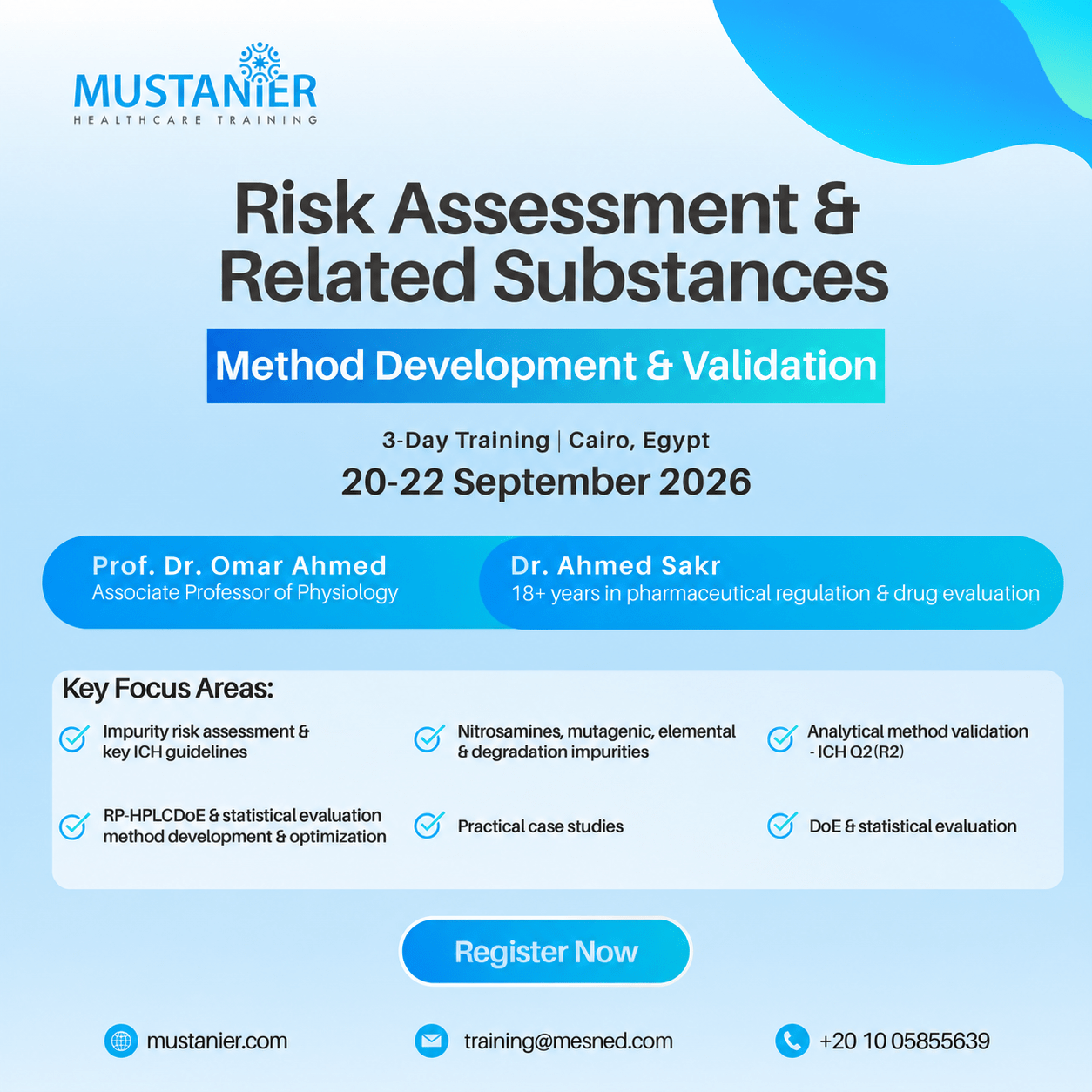
Date: 20-22 September 2026
Delivery: On-site, Cairo, Egypt
Build a strong foundation in risk assessment with this practical workshop and gain the confidence to assess and manage pharmaceutical risks.
Outlines:
- Impurity risk assessment & key ICH guidelines
- Nitrosamines, mutagenic, elemental & degradation impurities
- Analytical method validation – ICH Q2(R2)
- RP-HPLC & DoE (Design of Experiments) – method development & optimization
- Practical case studies
- DoE & statistical evaluation
Objective:
By the end of this training, participants will be able to:
- Understand the regulatory framework governing pharmaceutical impurities
- Identify and classify pharmaceutical impurities
- Perform systematic impurity risk assessments
- Apply ICH M7 principles to the assessment of mutagenic impurities and nitrosamines
- Evaluate elemental impurity risks according to ICH Q3D
- Assess residual solvent risks according to ICH Q3C.
- Evaluate degradation and stability-related impurities
- Assess extractables and leachable risks.
- Integrate different impurity risks into an overall risk assessment.
- Develop and optimize RP-HPLC methods.
- Select appropriate chromatographic columns and mobile-phase conditions,
- Apply Design of Experiments (DoE) principles
- Optimize sample preparation and detection conditions
- Evaluate HPLC system suitability and method performance
- Design and evaluate analytical method validation studies according to ICH Q2(R2),
- Interpret analytical validation data statistically
- Apply the acquired knowledge through practical case studies
Targeted Attendees:
- R&D seniors & juniors (Methodology scientists, Formulators, process Development,validation specialists)
- Quality Compliance managers & QA specialists
- Quality control managers & specialists
- Stability Specialists & RAs specialists and managers
Speakers Biography:
- Dr. Ahmed Sakr is an accomplished Regulatory Affairs Director with over 18 years of experience in pharmaceutical regulation, drug evaluation, and technical assessment. He brings proven expertise in CTD dossier review, risk-based product assessment, quality management systems, and international regulatory harmonization, with a strong track record of leading cross-functional teams and integrating global best practices into national regulatory frameworks. Throughout his career, he has played a key role in shaping regulatory policy and strengthening pharmaceutical oversight at both national and institutional levels.
- Prof. Dr Omar Ahmed “Associate professor of physiology”